
Don't Read if You'd Rather Burn Out Early
I've only been building this business full-time for a few weeks. I'm already feeling the anxiety.
Read this later - send a copy to yourself and receive weekly essays on Sunday mornings
One essay every Sunday morning. Unsubscribe anytime.

I didn’t plan to start out this year building a product. I was more interested in attracting job opportunities, perhaps clients. I had several projects I was working on to build out my portfolio, while I sussed out what I wanted my brand to be and what content I should create. If you’ve been on this newsletter long enough, you might’ve noticed some of my earlier posts were about “how to with AI coding” topics.
I talk about this as if I’ve been on this odyssey for years, but for me I didn’t truly commit to building a business till the end of July (if not August). I’m only a few weeks into the journey. And I’m ALREADY feeling the anxiety.
When the numbers aren’t moving, you still need to be involved day in and day out just to have a shot at making it work.
Doing the work full-time doesn’t automatically make it easier. I miss the structure, habits, camaraderie, and of course the income of full-time work. Some days it feels like I’m adrift in the ocean without a rudder or a sail.1
About 1 in 5 U.S. business establishments close within their first year.2 No one tells you how hard it is to even get to year 1.
People say it can take 10 years to be an overnight success. Biz Stone, Twitter co-founder, put it this way: “Ten years and a lot of hard work will eventually make you look like an overnight success.”3
Manuel Koser, co-founder and managing director of the venture investor Silvertree Holdings, described the kind of founder he looks for as “tenacious, passionate, and driven by a cause rather than just money or status.”4
It sounds better in retrospect than it feels while you’re still at the beginning.
Something kept gnawing at me
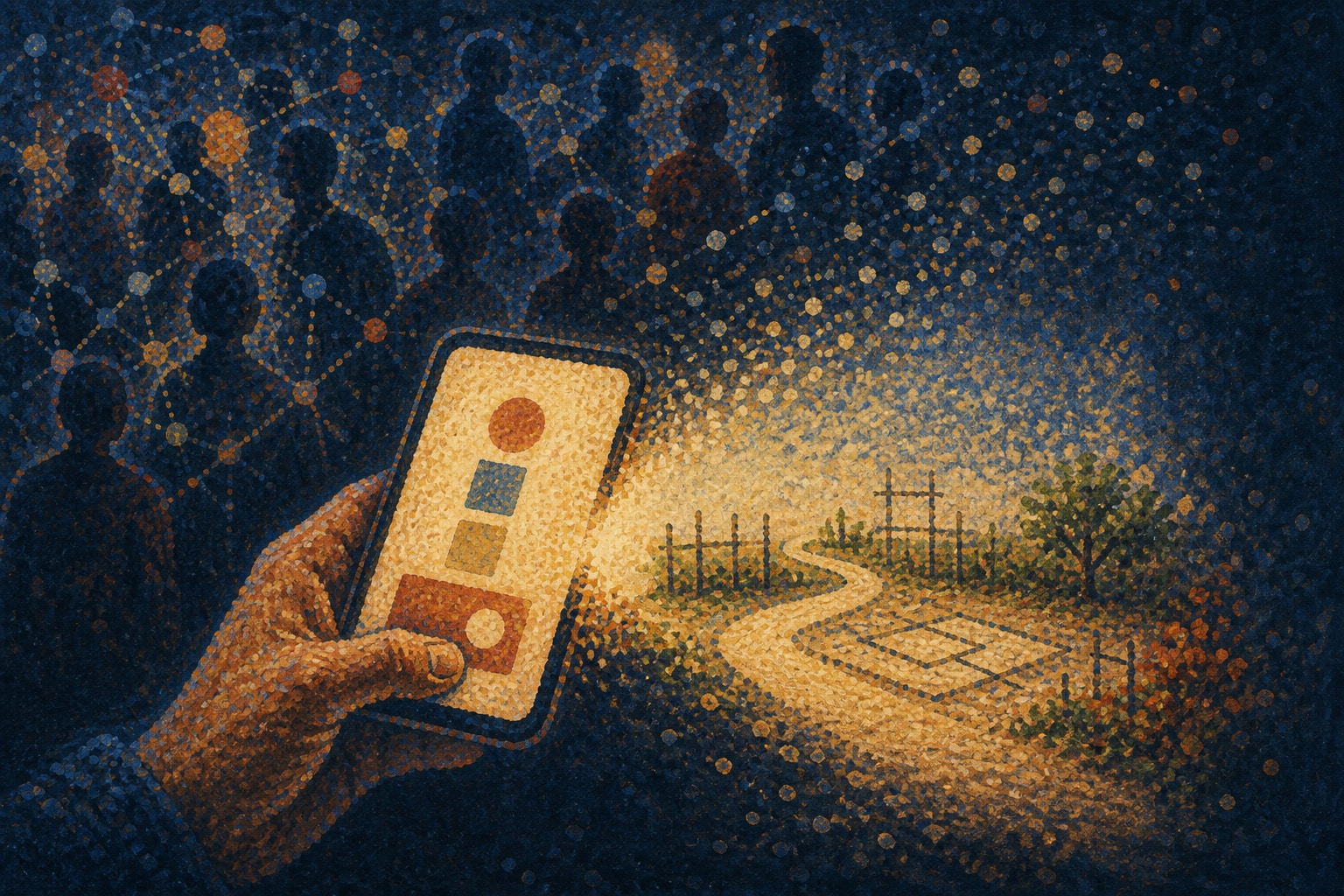
I felt like I was ignoring the biggest problems and the most meaningful work I could be doing. A voting prompt I shared in March during the Texas primaries received over 200K views on Reddit.5 I had thought about turning it into a much more seamless app experience but didn’t have the time to commit to it amidst all the portfolio and professional brand building.
I also learned through the first several months that I couldn’t commit to the professional brand building either. The networking events left me feeling empty and drained. The content I wrote felt like I was holding my breath. Consuming that content felt like living inside a bubble with one’s head stuck in the sand while the world around us was falling into greater chaos.
But did you try out that new AI agent? Man, isn’t that worth something?
It might’ve been ADHD but it was probably a deeper sense of values that I felt were being ignored as I kept trying to make the professional thing stick. I probably would’ve kept trying to suck it up for the year had it not been for my coach.
She asked me, “Aren’t you assuming that the only way this could work is by forcing yourself into a shape you don’t want?”
She called me out for ignoring the path I felt called to, one of social values and solving deeper problems like money in politics, that I was assuming it would not succeed. And the truth is, I hadn’t even tried it yet.
I realized I could’ve just been treating this like an experiment instead of a 10-year march. So I gave myself 3 months to lean into that energy and instinct that wouldn’t let me go.
I didn’t get to month 3. Because it took less than a month on the journey for me to realize that this was it.
That’s signal
At one point, I randomly recalled a childhood memory. I was 11-12, imagining how I’d like to help society in some way but unsure what that meant. I knew that if that younger me could see me now, she’d be so proud.
That’s signal. It’s not the numbers on your dashboard or socials going up. It’s the feeling that something here is worth pursuing.

That VC wasn’t saying founders who chase money are doomed. Money is useful. His point was narrower: money or status aren’t enough to carry you through the work. Uri Levine has a similar line: “Fall in love with the problem, not the solution.”6
I think I get what it means to put your all into something without external validation. Some days the only satisfying part is that I got to work on it at all. That has to be enough to carry you through the long stretch between starting and being seen.
It’s like creating art. Something you do purely from expression, a sense of play and love.
I had to learn along the way that I couldn’t focus on the outcomes. Each time I did, I’d be swayed by some content or business guru’s bag of magic tricks to get results fast. I’d spend days doubting everything I’m doing and trying anything I could to get things moving faster.
I’d end up spending less time on what I should be focusing on: the building and the writing. I got caught up in the outcomes.
Are there any product people in this audience? Any MBAs or people with a business degree? STEM folks?
Good. You need to hear this.
Our training has taught us to defend ourselves. We have to be up there at the boardroom or product strategy meeting, ready to defend our plans with hard-hitting data, empirical evidence, and bullet-proof arguments.
And that kind of thinking is going to get you stuck when you’re trying to build something new, like I am.
I kept looking for data and proven frameworks when there weren’t any. I tried to find someone with my exact configuration: doing my thing, in the same market, with the same constraints, experience, and skills. I wanted proof that what I was attempting wasn’t crazy.
I wasn’t going to find them. There is no other exact configuration of me, with my life experiences, my exact moment in history, my exact set of thoughts and passions and skills.
I was using the search for proof to delay starting.
Our business-heavy backgrounds and cultures teach us to treat anything that can’t be quantified as irrelevant. If it can’t be measured, it’s not to be taken seriously.
I know this from the knowing glances and candid interviews product people share on places like Lenny’s: no matter how much information we analyze, it doesn’t bring us any clarity on the toughest problem of figuring out what’s worth building.
Yes, it’s helpful. But you can’t rely on data to make the decision. At some point you have to use your instincts and intuition. That fuzzy stuff that business people and consultants turn their noses up at?
It’s the stuff you know because you’ve done the work, watched people react, and noticed when something feels wrong before you can explain why.
I once heard a story about a businessperson who swore he relied on data for big decisions. His child disagreed: the real test was whether the decision gave him a stomachache.7 I still remember it, even though I can’t remember who told me.
Some of what matters can’t be measured yet. Some of it may never be measured cleanly.
The research is useful here because it refuses to turn intuition into magic. Bodily signals can shape emotion and intuitive decisions, but intuition is not a private oracle. Sometimes it is experience noticing a pattern before I have words for it. Sometimes it is fear, desire, or plain old stress.8910
Facts are good for constraints and feedback. They tell me what happened, what is changing, and whether the thing I tried actually worked. They are not a substitute for deciding what is worth trying next.
Intuition is useful for noticing what I keep returning to, what feels wrong even when I can make a rational case for it, and what I care enough about to keep exploring. It is not a verdict. It has to go back through the world and be tested.

So where did that leave me when the numbers weren’t providing any relief?
I stopped holding myself to those outcomes. It was far too early to tell anyway.
I tried to lean into the creative, artistic energy and the sense of play and expression. Whenever fear showed up, I imagined it as my little mind screaming its anxieties and anger into the air like a tiny rain frog.
Because that’s all it is. I can let it have its say, pat it on the head, thank it for its input, and do the thing I was going to do anyway.
I used to end my days and weeks feeling braindead and exhausted, even though I’ve just been sitting all day. Decisions were so hard and I’d waste weeks to months second guessing myself. My ADHD made organizing my days feel like sand slipping through my fingers, and I relied on tons of systems and tools to try to stay on top of everything.
These days, it’s like my body’s on ASMR tingles and my mind’s tuned to a Zen radio channel - I’m much more present and aware of my day, experiencing it. I don’t need the systems as much and I still feel like I get a lot of meaningful things done. I make progress where it counts and I don’t miss the things I had to say no to.

All the best,
Muxin
References
Footnotes
-
“Understanding entrepreneurs’ loneliness: An integrative review of loneliness in management research,” Journal of Small Business Management, 2025. The review synthesizes research linking entrepreneurial uncertainty, workload, limited resources, and perceived lack of support with vulnerability to loneliness. Source ↩
-
U.S. Bureau of Labor Statistics, “34.7 percent of business establishments born in 2013 were still operating in 2023,” The Economics Daily, January 12, 2024. The total private-sector one-year survival rate in that cohort was 79.6%; the scope is U.S. private-sector establishments, not all startups or VC-backed ventures. Source ↩
-
Biz Stone, interview with WBUR’s Here & Now, “Biz Stone On ‘Things A Little Bird Told Me’,” April 1, 2014. The interview identifies the source book as Things a Little Bird Told Me: Confessions of the Creative Mind, Grand Central Publishing. Source ↩
-
Manuel Koser, “Expert interview: Co-founder of South African VC firm Manuel Koser shares top tips for building a great startup,” Silvertree Holdings, August 21, 2020. Source ↩
-
Author’s own Reddit analytics/post data. The linked post verifies the public post itself; the 200K view figure comes from the author’s account analytics, not from the post page. Reddit post ↩
-
Uri Levine, Fall in Love with the Problem, Not the Solution: A Handbook for Entrepreneurs, Matt Holt Books, 2023. The phrase is the book’s title and organizing idea; Levine is the co-founder of Waze and former investor/board member in Moovit. Publisher page ↩
-
I could not identify the original speaker or source of this stomachache anecdote after searching exact-phrase variations and related business and decision-making sources. Keep it as a clearly marked secondhand story, not a verified quotation. ↩
-
Antoine Bechara, Hanna Damasio, Daniel Tranel, and Antonio R. Damasio, “Deciding advantageously before knowing the advantageous strategy,” Science 275, no. 5304 (1997): 1293-1295. PubMed ↩
-
Barnaby D. Dunn, Hannah C. Galton, Ruth Morgan, and others, “Listening to Your Heart: How Interoception Shapes Emotion Experience and Intuitive Decision Making,” Psychological Science 21, no. 12 (2010): 1835-1844. The study connects interoceptive accuracy with emotional experience and shows that bodily signals can support or interfere with intuitive decisions depending on the situation. PubMed ↩
-
Manuel G. Bedia and Ezequiel Di Paolo, “Unreliable Gut Feelings Can Lead to Correct Decisions: The Somatic Marker Hypothesis in Non-Linear Decision Chains,” Frontiers in Psychology 3 (2012): 384. This hypothesis paper argues that gut feelings are context-dependent and can be unreliable, which is why bodily signals work best as information to examine rather than as automatic proof. PubMed · Full text ↩