Power to the People
Where Voter Choice is at, and where it’s headed next.
Read this later - send a copy to yourself and receive a new story every Sunday
One story every Sunday. Unsubscribe anytime.
To say this last week was a blur is an understatement.
Some of you know I’ve been building out Voter Choice - a project that started out as a way to combat money in politics by making it easier for people to see who funds their members of Congress and how those members have voted. It has since evolved into a ballot research tool that focuses on candidates’ actions instead of their campaign promises.
Monday night, before Election Day, I pulled an all-nighter trying to add more features, more user conveniences, and more researched ballots to the app. I won’t go into the list of technical, legal, and business challenges that kept making the app less user-friendly and more expensive to run than it was worth to a voter.
What mattered was watching Shiva, an acquaintance I met through LinkedIn, try to research his ballot with the app and me realizing, “This product isn’t it.”
The problem was real - I was receiving unsolicited traffic from people trying to research their ballots. Yet none of them went through the app experience all the way. Even for those trying to use the app, like Shiva, it wasn’t clear how to turn that information into a decision.
Is a candidate good if they’ve raised the most money, if a vast majority of it was from individual donors? Or does it simply mean they were the party favorite, an institutional actor during a time in which public trust in institutions are at an all-time low?
Seeing the information didn’t necessarily help people interpret it or decide how to vote.
I remember a call with Masuma months ago, who shared her own experience building out an election tool at The Washington Post, and later her own attempt to make a decision between two candidates she knew very well. “I spent hours on research,” she said. “I felt no clearer about which candidate was honestly better.”
She came away from both experiences doubting the value of information in bringing about any clarity, despite the ongoing chorus that ‘informed citizens’ were necessary to our democracy.

That same kind of confusion was happening as I watched Shiva attempt to use Voter Choice for his ballot. As he talked through his confusion, I knew that simply displaying ballot information wasn’t enough.
After our call, I went back to my computer trying to figure out how to build what I felt was a better solution for voters. I had not slept for over 30 hours, but it was already Election Day and there were several hours left at the polls.
Within four hours, I had rebuilt Voter Choice as a connector in Claude, letting people work through their ballots in conversation with AI. The difference was immediate: A user can ask for any kind of assistance and get personalized guidance.
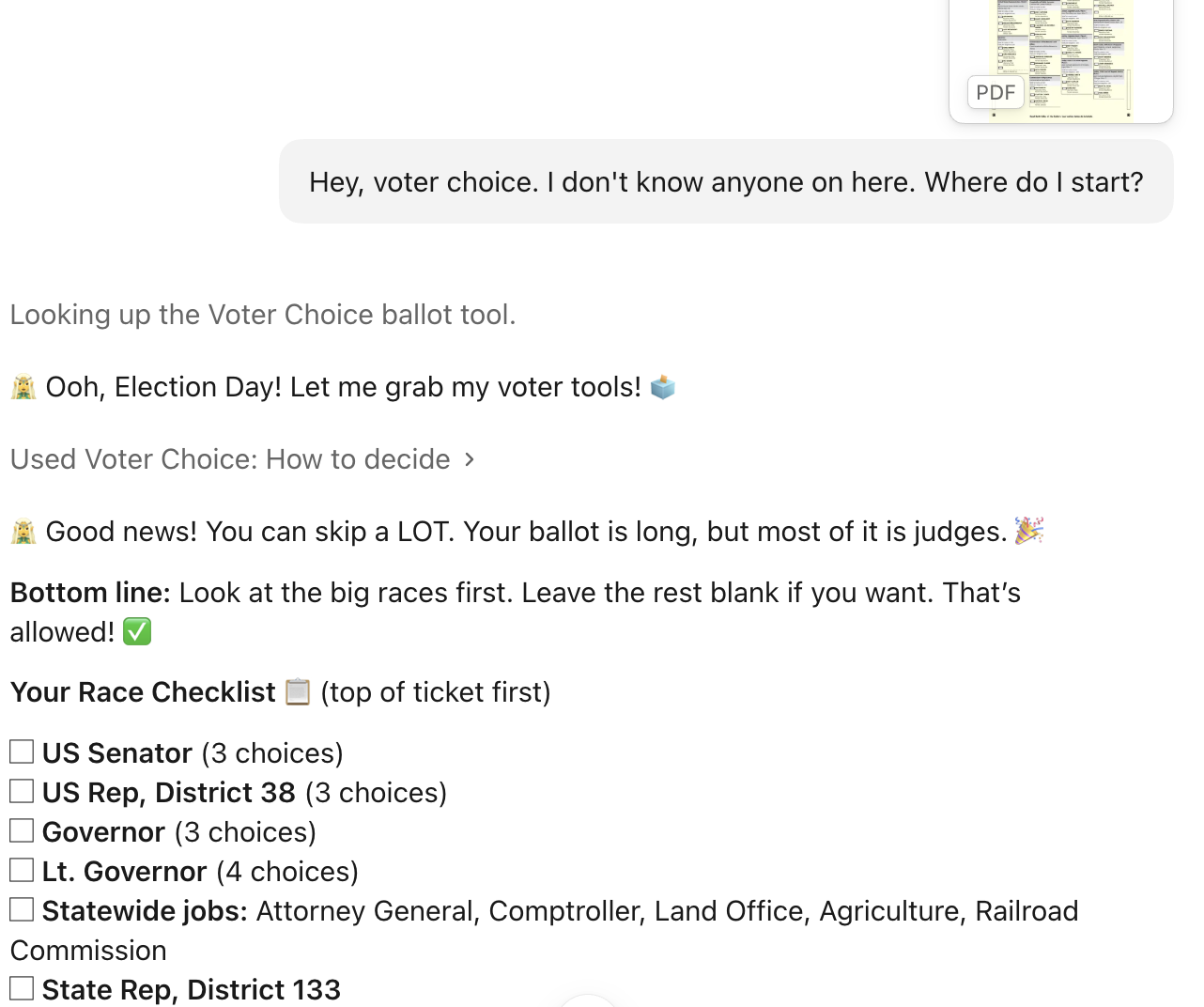
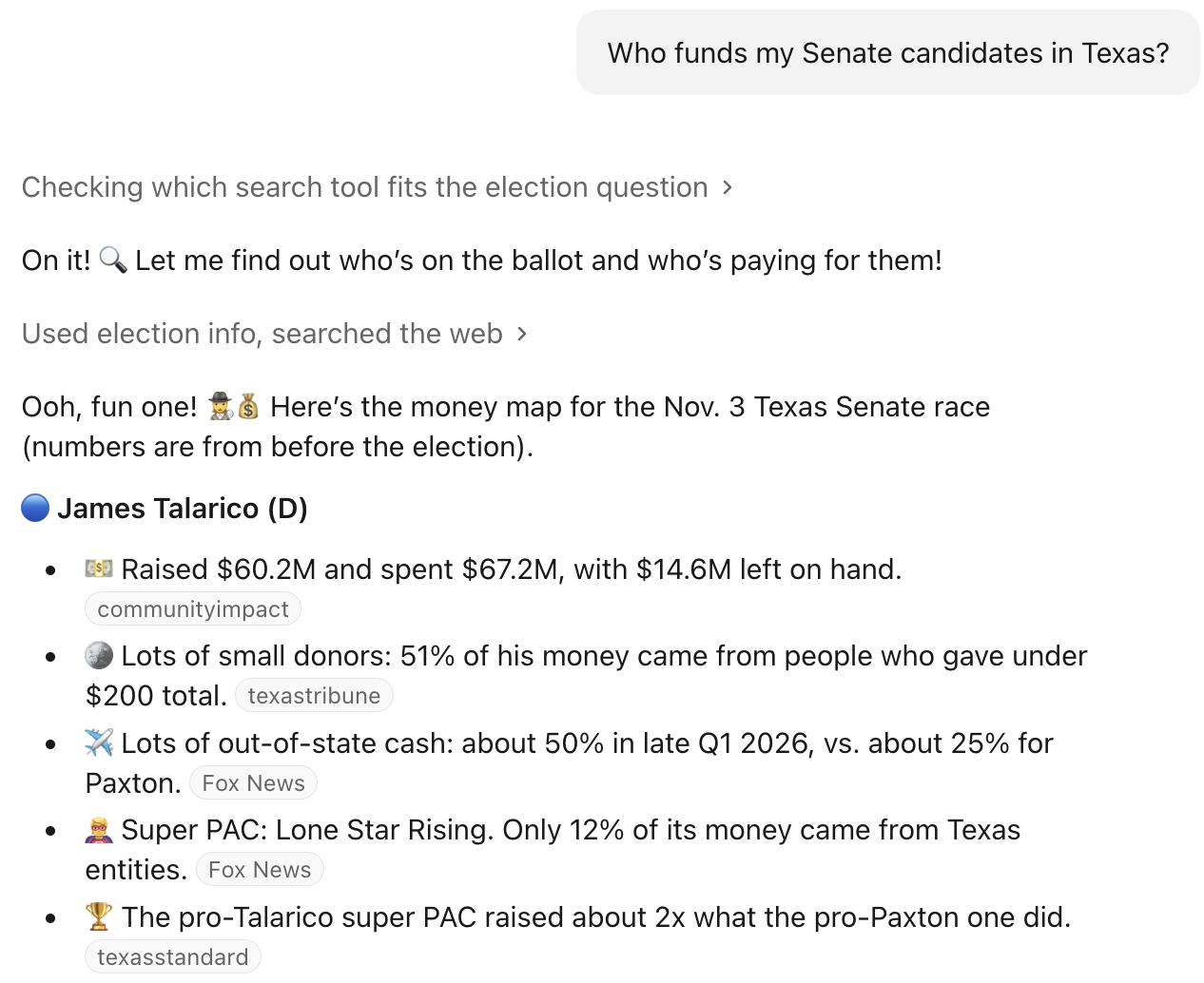
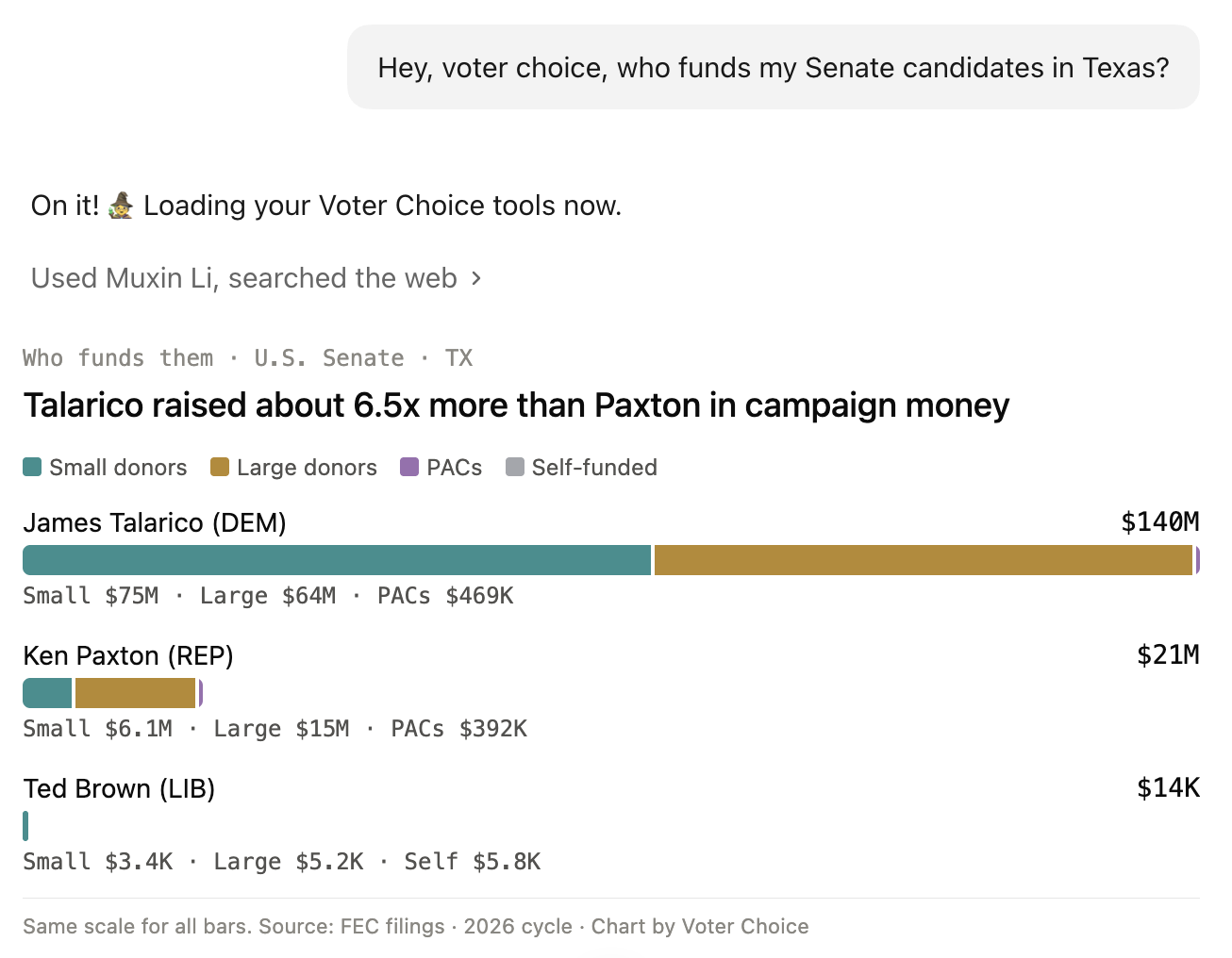
Using AI for ballot research has become common these days, but they are prone to hallucinations and errors. Without Voter Choice, even a simple question like, “Who funds the Texas Senate candidates?” can be answered three different ways. AI would conduct web research, but its results can be incomplete, dated, and hard to interpret.
Meanwhile, with Voter Choice as a connector, it pulled the full campaign donation history per candidate from the official FEC sources, and used its visualization skill to organize the donors into groups to make sense of the data.
While it was a little too late for the current elections, the new product direction was far more promising. It will likely not be proven out until the next election or runoff when citizens have a reason to look at a ballot again.
But it was also incomplete.
I spent the entire next day wondering - what can ordinary people do to hold power accountable once elections are over?
“How to Keep Power Accountable - After the Elections?”
When I posed this question in discussion forums, many weren’t sure what more accountability would look like beyond the elections. Yet the work that affects our lives is carried out daily, by decisions and votes on laws most of us are unaware of. To say that our elections are the only means to get accountability from our politicians is like saying they only care about our opinion every few to several years.
How do we make our voices heard throughout their terms, while they’re making policy on AI, healthcare, and wages?
Many of us feel that the system is rigged and no longer representing what we care about. But what would need to happen in order to steer it in the direction we would want? What power can we exercise as individuals?
For instance, we are allowed to contact our representatives directly and voice our opinion on a bill. But that means being informed about a bill enough to know why we would care, realizing that contacting our representatives is even an option, or that it actually works.
Did you know that contacting your representative about a specific bill can influence their vote? Make your request while the decision is still pending.
Did you know that both personal emails and phone calls can make your voice heard? You don’t have to call to participate.
Did you know that identifying yourself as a constituent matters? Offices track local views, and the number of messages can matter too.
Or that, in one congressional experiment, identifying constituents as campaign donors made access to senior officials more than three times as likely?
Did you know that you can weigh in on bills through public hearings and written testimony in state legislatures like Washington’s?
Most of us do not know that. Our civics classes taught us the names of the bodies of the government and how elections work, but not how to use our own power effectively to steer outcomes.
I want Voter Choice to be the all-in civic tool that not only makes these options known to you, but also makes the process of being an engaged citizen far easier. In the next version, with AI powering it through even a free Claude account, it can detect if bills that affect the issues you care about are being proposed.
It can categorize and find which laws could have a potential impact directly on your life or your small business. It can scan for national, state, and local level policies, and tell you what options you have to steer them - from contacting your representatives, starting a petition, to showing up to the city council meeting at 1pm on November 19.

My proudest moment this week came when Aaron Ping, a father and advocate for online child safety, sent me a “HOLY BEJEEEEEEZUS!!” after I mentioned that Voter Choice had discovered a federal bill to get major tech companies to turn over information to law enforcement generally within 72 hours of a warrant, instead of weeks. These delays can cause investigations into drug dealers and predators who operate on social platforms to stall, and affected families have been working tirelessly to get more sensible rules in place to protect their children.
The bill had been proposed in Congress in February, announced a few times through the news, then faded into the ether like many things that can happen on the internet. I can’t help but wonder if a tool like Voter Choice existed earlier, how much sooner the families would have been alerted to its existence, how much further the bill could have progressed by now with people’s continuous and timely pressure, and how many more lives that might have helped save along the way.
Yet up until this point, the technology we had would require us to create custom alerts based on very rough filters, and we would have to read every update from every channel to know if it was relevant to us. There was no good way to do this while trying to hold down a life as a working adult.

But with AI and Voter Choice, policy updates relevant to the issues we care about will get surfaced. Instead of reading pages of legalese, AI could summarize in plain language and keep updates at a high level. Because it will scan national, state, and local sources, things that are easy to miss from the news but highly relevant become part of a weekly digest you can scan quickly.
I recently built an integration for King County, Washington, and it surfaced proposals to increase permit fees on pet care businesses:
Pet business permit fees. The Board of Health is the county’s public health rule-making group. Pet businesses pay these fees directly.
- Grooming, mobile grooming and pet food stores: $270 to $468.
- Standard pet shops: $486 to $644.
- Boarding and daycare: $585 to $936, depending on size (was $486).
- Large shelters: $1,026 to $1,170.
- Plan-review and variance fees rise too. The penalty for opening without a permit would go from half the fee to the full fee.
- Not final. It was postponed Oct 15. It starts Jan 1, 2027 if passed.
- Nov 19, 1:00 PM PT. How to take part · Item record
This would never make it to national news. But it’s highly relevant to specific residents of King County. If anyone did take issue with it, they’d have a chance to raise it.
A Voice at the Table
What’s probably been the most fascinating to me is how much power we actually have as ordinary citizens over the very system we feel constrained by. Just knowing that these options existed gave me a much deeper appreciation for the kind of country I live in - that we have legal routes to take, that are inexpensive and could be incredibly impactful, to shape the world into one we’d be more satisfied by.
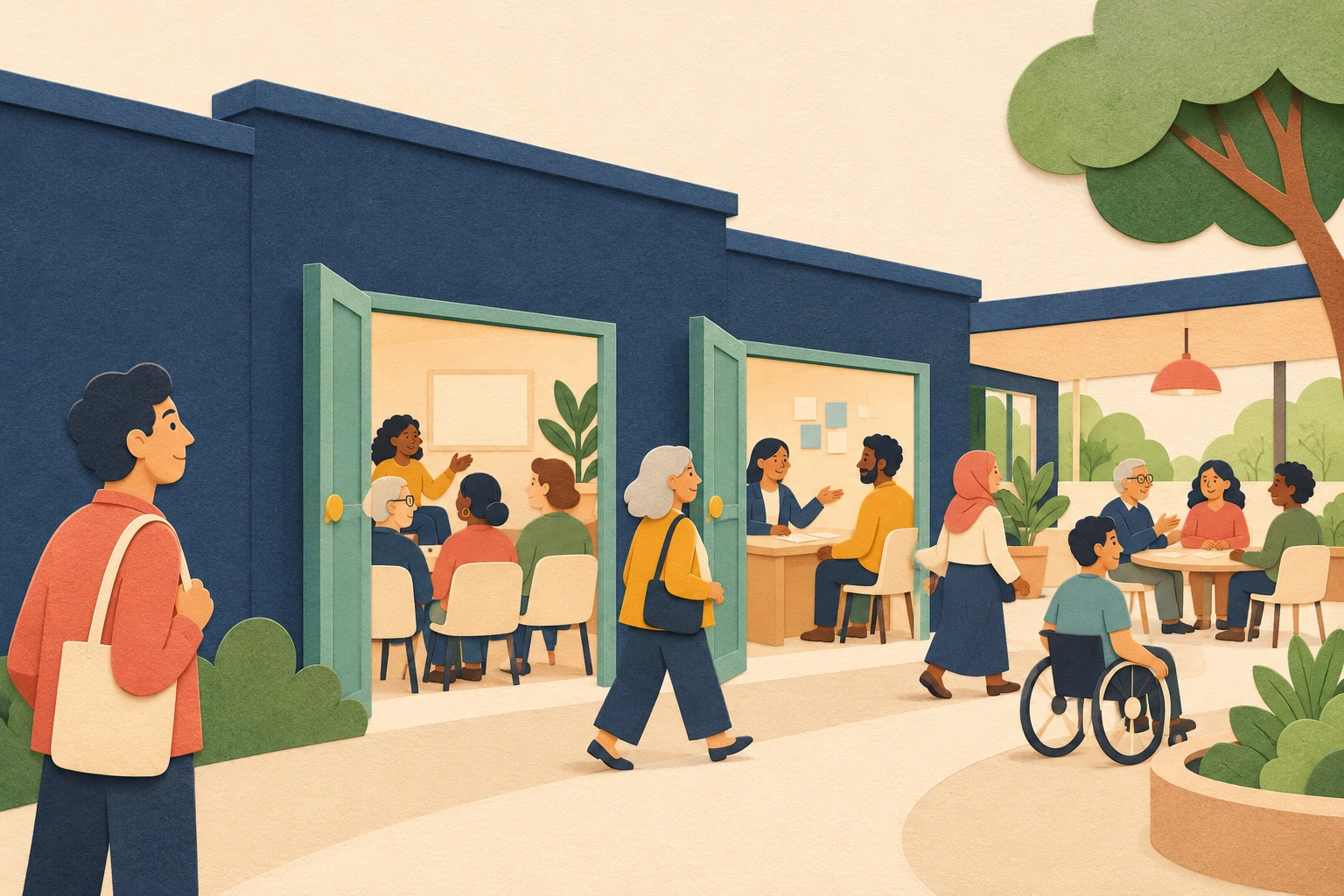
Elections are a big part of our democracy, yet a democracy can’t all just be about elections. If anything, this year taught me that democracy is a practice, as much as your exercise and meditation is a practice that stays alive and yields rewards through your regular application.
I also believe that each person should be free to decide just how involved they want to be. It’s possible that a vast majority of us will continue to vote and discuss politics the way we have been for decades - like a two party sports team rivalry where identity politics overrides other considerations. I don’t believe it’s healthy, but I also don’t believe it’s practical to expect radical changes to habits formed over decades of socialization.
I also believe in that quote, “Never doubt that a small group of caring people have the power to change the world.” As Dr. Chenoweth once observed of massive societal movements, it took less than 4% of the population to be dedicated to the cause. A massive shift does not necessarily require the majority to initiate it - it can start with just a few dedicated people.
It can start with you.
Get progress updates and be notified when the next version of Voter Choice lands at voterchoice.vote
