
The world's broken. What do we do?
An early map of where ordinary people can find leverage, and how we keep the work alive.
Read this later - send a copy to yourself and receive weekly essays on Sunday mornings
One essay every Sunday morning. Unsubscribe anytime.
The world is not going to be saved by one brilliant leader, one election, or one AI model.
It will change when ordinary people learn where their leverage is, and build it together.
This is the question I’ve been hearing a lot lately, mostly because I’ve also been asking it myself. I’ve been looking for other people who are trying to figure it out together, too.
I’ve heard attempts to answer it ranging from deeper questions about how a society must function to whether recent protests have led to change. I’ve collected observations and ideas from a variety of perspectives. Maybe not enough to be considered a well-designed research study, but enough to make me want to organize the thoughts I’ve collected and start trying to make sense of them.
We know the problems are big and complex. We also know that new technology like AI won’t save us if we don’t change the systems around it first. Wealth inequality and the tight capture of money and power have been problems for centuries. Technology alone has not solved these critical social issues.
If too many people and institutions are extracting value without returning it, the socioeconomic and environmental ecosystems we all depend on eventually collapse. If AI simply automates and scales up the decisions that led us here, then we are going to accelerate the collapse unless we change the conditions first.
But making change happen will take more than ideas and intentions.
Democracy is at risk, and without democracy, the demands of the people will not be honored. At its core, democracy means that the power to shape human society belongs to all of us, not just a few people at the top.
Whether you care about LGBTQ+ or immigrant rights, better wages or better schools, your concerns do not turn into reality if you do not have the power to influence society. Right now, too few people hold too much power. Their wills, rather than the will of the majority, are shaping policies and the world we live in.1
So democracy is where I would start. Without it, we have no meaningful power to shape the future.
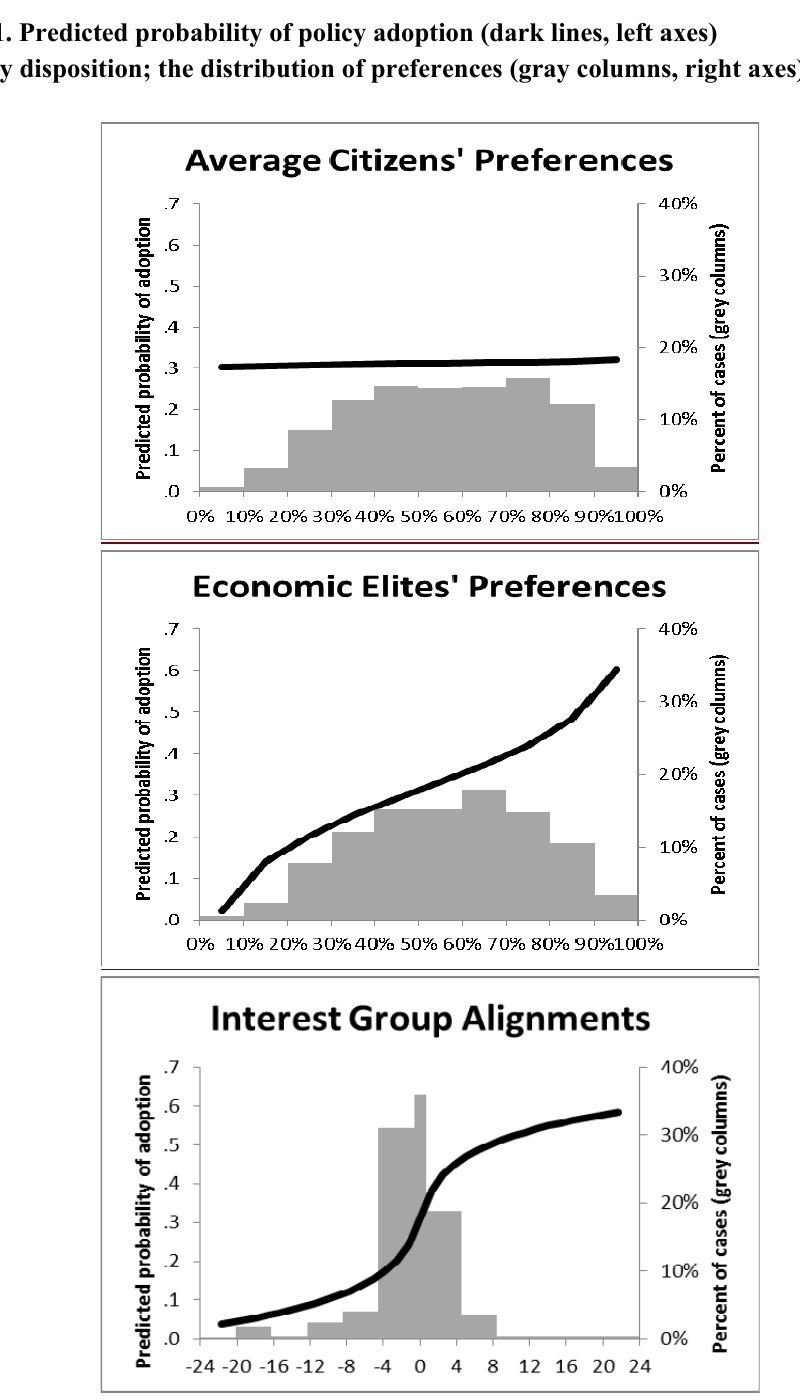
The top line that represents probability of adopting a policy stays almost flat as average-citizen support rises. But in the middle and bottom charts, that probability line rises as economic-elite and interest group support rises. Gilens and Page, Figure 1.1
How do ordinary people deploy power?
Democracy isn’t just voting and elections. It is the power for people to shape their society according to their wills.
Power requires leverage. What pressures can we apply that directly motivate others to action? The cost of ignoring that pressure has to be stronger than the incentives that keep things the way they are. Otherwise, our efforts are ineffective.
The forms of leverage I see most clearly are our votes, our labor, our spending, our care for one another, and our ability to build new tools and institutions.
This is just a primer, not a deep dive. The goal is to provide an overview and a map of the territory.
Ignoring what money buys in campaigns
If state leaders mostly care about keeping their positions, they’ll do more of the things that keep them in their jobs. Currently, that often means raising enough money to remain competitive, because campaign spending is strongly associated with election results, especially for challengers.2
Money is not the only thing that determines an election. Incumbency, party, district, candidate quality, and the larger political environment matter, too. But fundraising and spending are part of the incentive structure candidates are responding to.
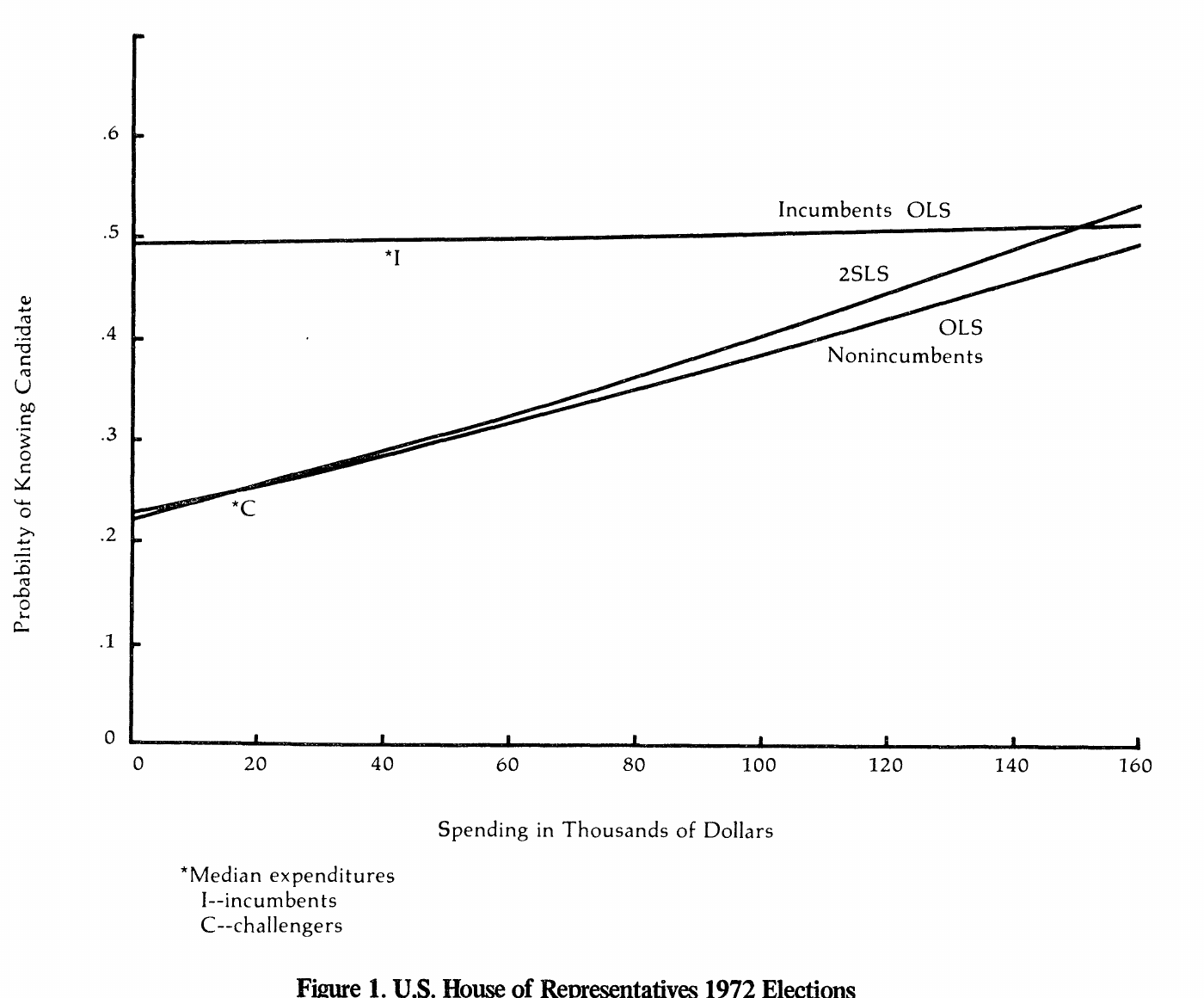
Money is not the only thing that determines an election. Incumbency, party, district, candidate quality, and the larger political environment matter, too. But fundraising and spending are part of the incentive structure candidates are responding to. Original figure: Jacobson, Figure 1, p. 484.2
Citizens are the ones who ultimately decide how to vote. If we choose to ignore heavily funded campaign messaging and choose our representatives based on their actions, we can tie the incentives of state leaders closer to the basic premise of their job: Representing all of us.
What bills have they supported? What is their stock activity? Who have they accepted money from? What have they actually done with the power they were given?
It’s the reason I’m building a voting app to make this decision quick and easy. You can also ask an AI before your next local election about the candidates on your ballot. Focus on what actions they’ve taken, not just on their rhetoric.
People can say anything. Action is where it counts.
Alternative systems of care
The account I read was about how immigrant workers brought down Jim Crow in Hawai’i. The Big Five, five interlocking plantation companies, controlled more than 100,000 workers. They maintained power through ethnic division and disenfranchisement under a territorial government they controlled and maintained as a white, single-party oligarchy modeled after Jim Crow. Workers were segregated by ethnicity and race, paid differently, housed separately, and pitted against one another. Every previous strike had failed because it was organized along single-ethnic lines, which made it easy for the companies to use one group as strikebreakers against another.3
The breakthrough wasn’t a new tactic. It was a new relationship.
The ILWU built not just a multiracial union but a structurally cross-ethnic one. Leadership at every level was required to span ethnic groups, meetings were conducted in multiple languages, and shared work assignments made solidarity a daily practice rather than an abstract ideal. When 26,000 workers walked out in 1946, the plantation companies imported 6,000 Filipino workers as replacements. Filipino union members met them at the docks. The replacements stepped off the ships wearing union buttons.3
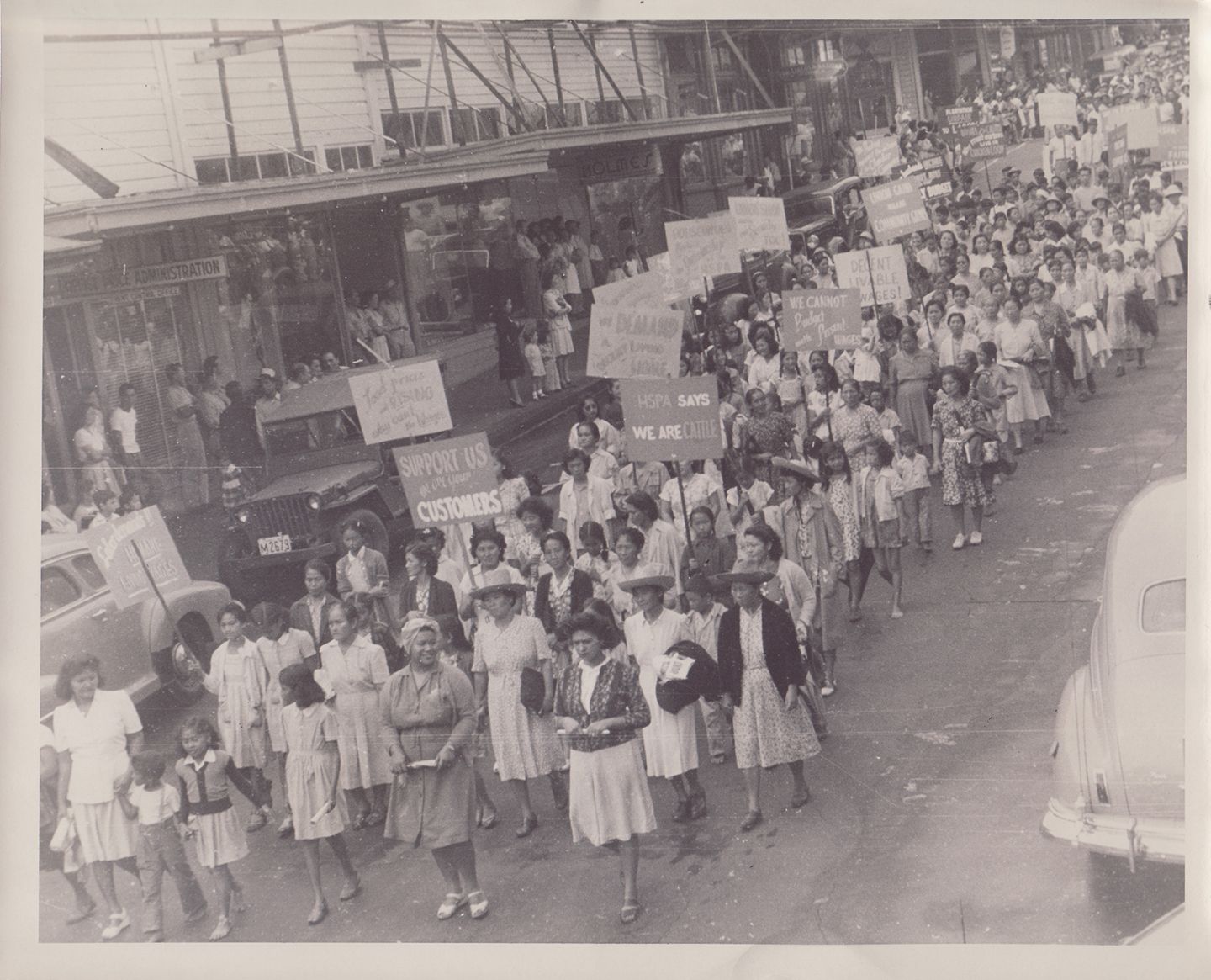
Women and children march through Hilo during the 1946 sugar strike. Their signs ask customers to support them and insist that they cannot stay silent. The strike became powerful because the companies could no longer turn one group of workers against another. Photograph: ILWU Archive, Hawai’i oral histories.4
Inclusion was the strategy - but building alternative systems of care was the infrastructure that held the effort together. From the original post:
What made 76,000 people hold together for 79 days was not militancy. It was infrastructure. The union organized fishing crews, hunting teams, communal food kitchens, a transportation network, community safety patrols, dance parties, backyard gardening collectives, alternative banking systems, and daily coordination across four islands. The goal was simple: no one goes hungry, no one is isolated, no one has to choose between the strike and feeding their family.
That infrastructure was also a direct assault on the plantation’s power. The Big Five’s coercive leverage depended entirely on workers’ material dependency - on company housing, company medical care, company stores. When the union built alternative systems of support, it didn’t just sustain the strike. It broke the dependency that made the plantation system possible.
In any system where authoritarians use people’s material vulnerability as a tool of control, building alternative systems of care is not charity.
It is resistance.
How might we create similar systems for ourselves, so that we do not have to rely as much on institutional power to receive what we need?
Doctors Without Borders is one example of an organization that provides medical care based on need, including care that is free of charge, in places affected by conflict, disease, disasters, and exclusion from health care.5
What if we built more local organizations that could provide simple care and essential services outside the usual institutional channels?
Bartering and favors can bring non-monetary services and essentials without relying entirely on financial institutions and currency created and owned by the state. I’m sure there are legalities to consider. But unofficial markets exist already.
We had an elderly neighbor everyone trusted for free after-school daycare, saving the families tens of thousands of dollars over the school years. Across multiple children and years of care, the value was probably much greater.6 She lived with her family instead of in a senior care home, saving more money.
Beyond the savings and the practical help, there is the importance of intergenerational households and community in general. We’re far more likely to empathize and come together when we aren’t filtering every valuable human interaction through money and turning everything into a transactional relationship.
Labor leverage
Despite what some AI companies claim, we have not fully replaced human work with all-knowing machines. There are still plenty of gaps in these models’ abilities to handle creative work and human judgment, not to mention the costs of their compute.
Workers still have specialized knowledge and real-world experience that companies cannot easily replace.
Labor strikes have proven to work in the past. Organized labor helped make the eight-hour workday a political and legal reality.7 Demonstrations are important, but they do not always create enough pressure by themselves. We need leverage, and labor is still one of our biggest leverage points.
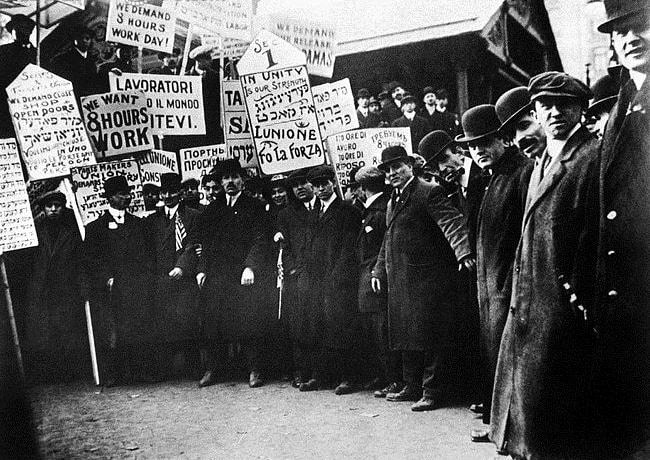
Garment workers carrying signs that said, “We demand 8 hours work day!” Photograph: Wikimedia Commons.8

Imagine removing all the workers from a company and leaving AI and upper management behind. Who would have the deep, updated understanding of how everything actually works? Without specialized knowledge and real-world tested experience, all you’d get is slop outcomes, which would eventually lead to failure in the market.
I won’t claim labor unions were free of their own problems. Some were run like authoritarian regimes. Others operated more like healthy democracies. There is the same challenge here as everywhere else: How do we organize large groups of people in a healthy way?9
But organized labor is a direct strike at the incentives of the biggest extractive actors, who want to profit immensely from our work, talents, and efforts. We ought to treat this form of leverage seriously.
Consumer boycotts and championing
I buy expensive pasture-raised eggs from Vital Farms because I want to support independent farmers, regenerative agriculture, and happy hens.
Have you seen how cute they are?

Cute as heck hens out on a pasture at a family-owned Vital Farms affiliated farm. Vital Farms, The Farm.10
Ben Cohen is asking consumers to boycott other Magnum brands so that the founders can pressure the company to sell Ben & Jerry’s back to them. He believes the corporate ownership has eroded the company’s core values.11
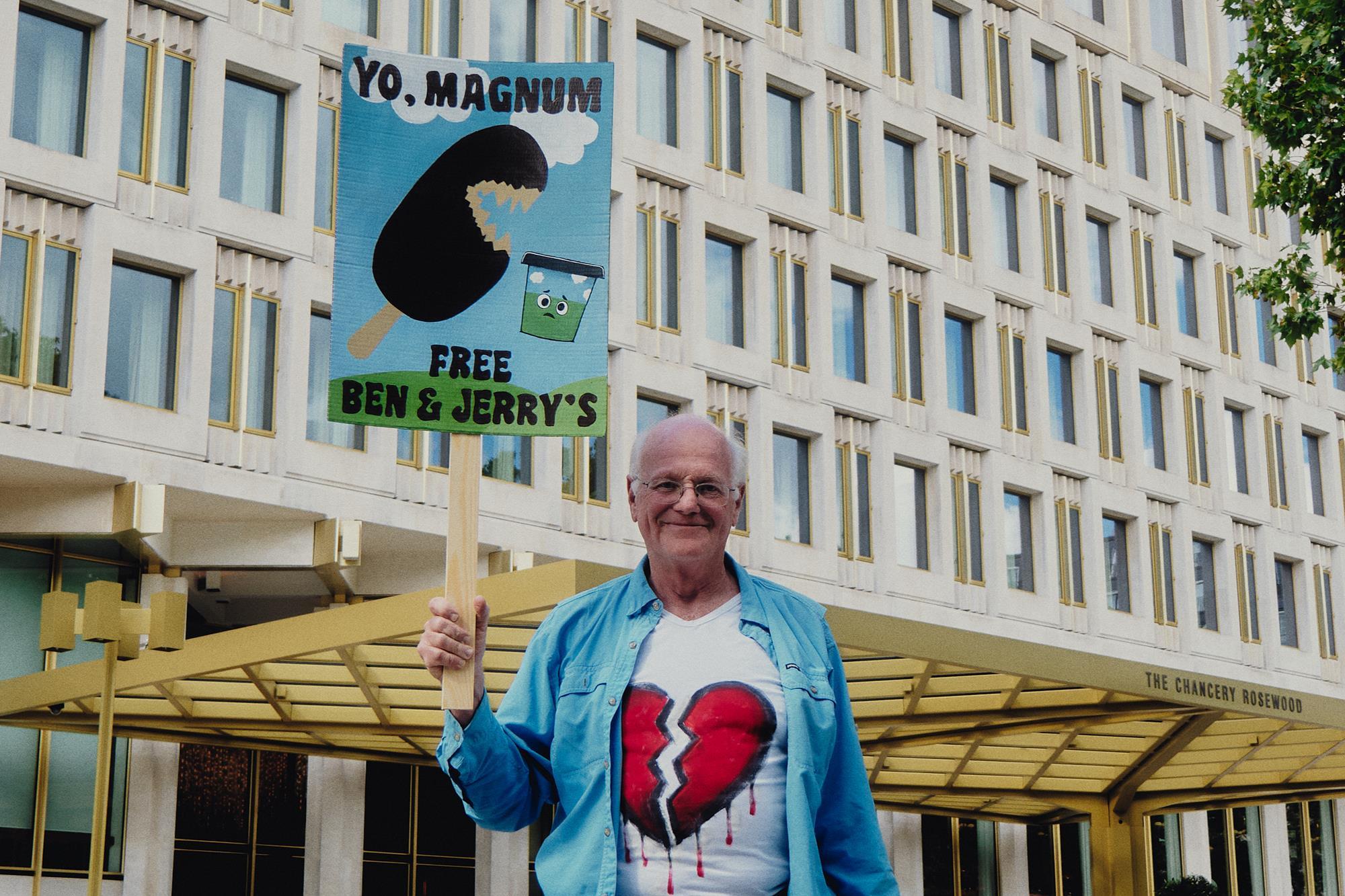
Ben Cohen is holding a hand-painted “Free Ben & Jerry’s” sign outside the Magnum Ice Cream Company’s capital markets day. Photograph: The Grocer.12
Starbucks Workers United is also asking consumers to boycott Starbucks until workers secure a fair union contract.13
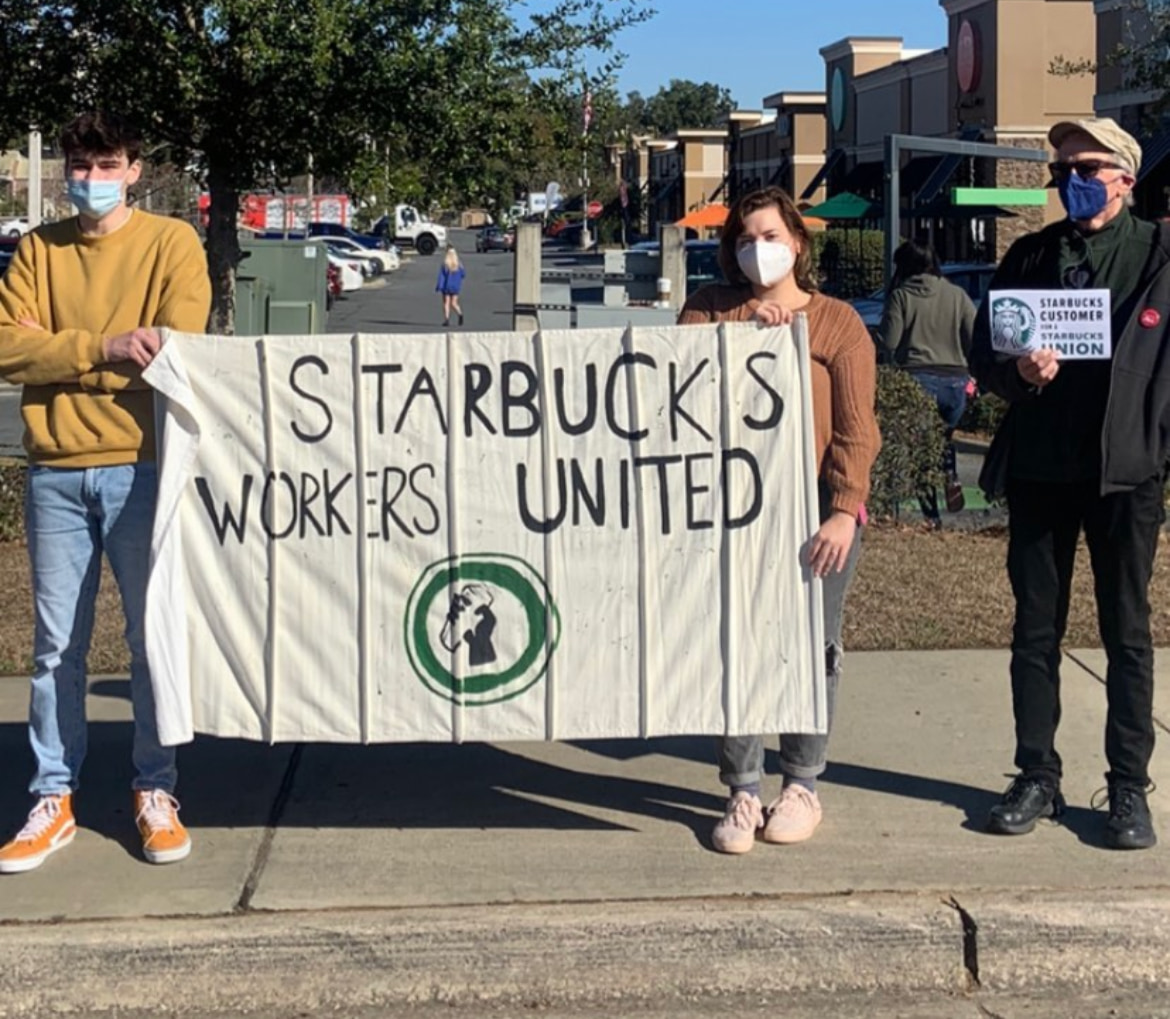
Workers and a customer supporter hold a Starbucks Workers United banner outside a store. The union’s “No Contract, No Coffee” campaign connects customers’ spending to workers’ demands. Photograph: Wikimedia Commons; campaign: Starbucks Workers United.14

Compared to the effort of organizing demonstrations and parading in the Southern summer heat, boycotting and supporting brands are some of the cheapest efforts we as consumers can make.
I understand that not everyone is privileged enough to decide which brand to buy from when grocery costs are hurting so many families. But if you do have that flexibility, or there is something you don’t really need, consider applying consumer pressure through boycotting and supporting brands.
What’s difficult about this is information and scale. I don’t exactly have an easy-to-access feed of verified boycotts and good brand alternatives to use during my weekly meal planning and grocery shopping.
Maybe someone out there ought to build this.
Maybe that someone is you.
Citizen software and Shatuga Brands
AI is making coding as easy as writing. No longer do you need the blessings of a venture capital fund or investors to pay for the upfront cost of making an idea come to life.
You can build things that solve real problems, even if they do not lead to a trillion-dollar exit in five years.
You can charge a lower price because your costs are lower, and your financial goals are not tied up with short-term moneyed interests. You can make something more accessible by keeping the price low.
Despite AI’s productivity gains, there are still many people who would not have had the time, skills, or wherewithal to build solutions themselves while juggling life and stress. They may not have been able to keep those solutions maintained and updated to people’s needs, either.
You can rely on word of mouth and community to spread something further. If you build something aimed at truly helping people, chances are it will get shared.
There is already a small version of this happening. Small businesses are getting attention by declaring that they do not use AI flyers or AI photos to promote themselves. People are hungry for evidence that something was made by a real person.15
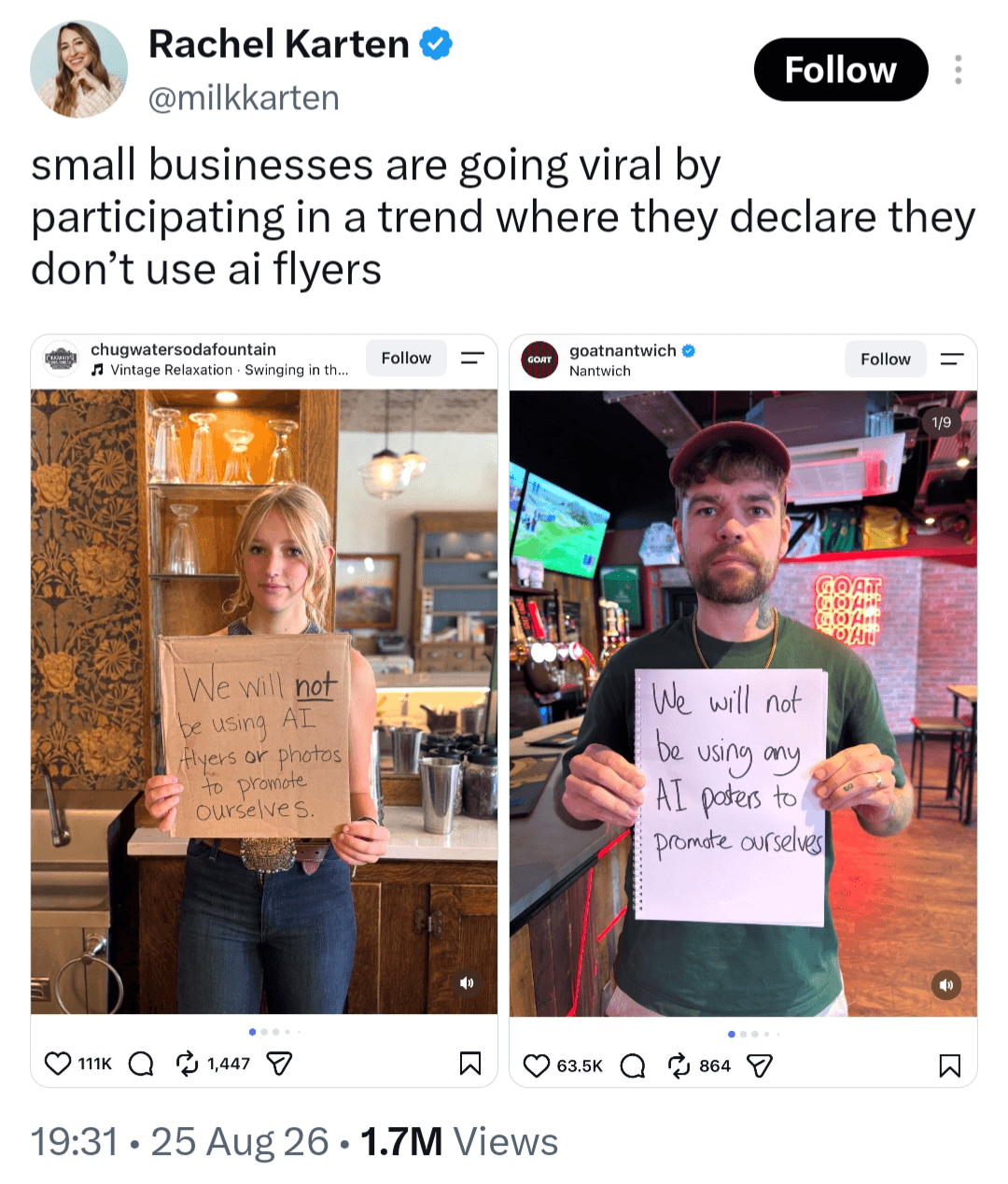
Two small businesses are holding handwritten signs saying they will not use AI flyers or photos to promote themselves. The screenshot says the post reached 1.7 million views. Screenshot: Rachel Karten.15
Shatuga Brands is one example of the kind of possibility I’m thinking about: Building smaller brands and products around useful ideas, rather than assuming every worthwhile project needs to become a massive company.16
You have options. You can decide to build the thing that makes it easier for millions of other people to take the kinds of actions I’ve described. You can come up with better ideas through deliberative democracy, using AI and other technology to help people think together and develop better ideas than they could develop apart.17
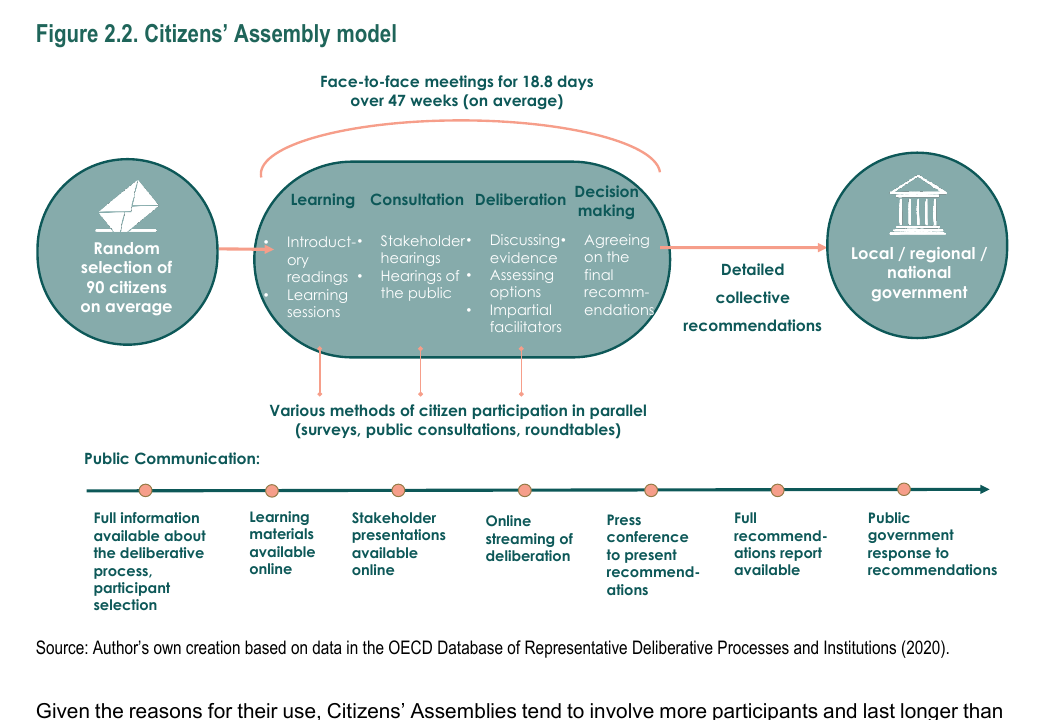
The OECD diagram follows about 90 randomly selected citizens through learning, consultation, deliberation, and collective recommendations to government. Original figure: OECD report, Figure 2.2, p. 37.18
Along the way, you can build a wealth asset, a community, and a brand you can take with you anywhere.
Coming alive
I don’t do any of this because I’m afraid, guilty, or angry.
I’m doing what I’m doing because it makes me happy.
I’ve never felt more aligned than I have this past month since I started committing to this journey.
One day, I recalled an old memory. My childhood self was 10 or 11 years old, thinking about who she wanted to be when she grew up. I didn’t have the words for it then, but I knew it had something to do with helping society in some way.
I realized that if my 11-year-old self could look at me now, she’d be proud.
My biggest takeaway from Atomic Habits is that you have to make the preferred habit more attractive than your status quo. Make it easier to do the thing you want any way you can.19
I still remember a story James Clear shares in his book about a smoker who was able to quit after reading a book that showed him how every benefit he thought he was getting from smoking was not actually true. If he really cared about spending time with his friends and enjoying his life, then quitting smoking was more aligned with what he wanted.
The book was written by an ex-smoker who knew what he was talking about. He knew what it was like to justify the habit with the stories he told himself.
So I see it as my honor to do something similar for anyone who has ever felt that the problems are too big to tackle and that it is better to live in our own protected bubble. Because that was me, too.
And trust me, you don’t really escape that gnawing feeling that there are bigger problems out there than worrying about your career or what to do this weekend. You think you can live in blissful ignorance, but your heart knows better.
You think you can distract yourself and enjoy your life fully if you just pay attention to the things you enjoy and ignore the rest.
But you know better.
There is a deeper wish you’ve been harboring secretly from the cynical world: You wish for things to be better. For some reason, it makes you sad that you have to hide that wish, even from yourself.
I used to think that if I attempted to make a difference, I would only make that pain worse. There is so much disappointment in the world.
But it turns out I was making the pain worse by not doing anything at all.
 An adult woman sits by the window while her 11-year-old self looks back at her.20
I won’t pretend to understand how this works. But I know that each conversation I’ve had with someone else who also felt crazy for wanting to make things better made that world feel a little more possible.
There were more people out there than I realized who wanted the same thing I did.
I also didn’t have to achieve those outcomes to feel fulfilled and more satisfied with my day-to-day life. I’m early in this journey, and we are still far from seeing any real change occur.
But this work is aligned with a part of me that has been wanting to come alive.
I feel a sense of satisfaction and fulfillment even without the outcomes, simply by doing the work.
I am also starting to believe that joy is not something we wait for after the work is done. It is part of how we sustain the work.
If we organize only around fear, guilt, anger, and opposition, eventually people become exhausted. We need a shared mission that gives people something to run toward, not only something to run away from.
There is a powerful example of this in the story of Chile’s 1988 “No” campaign against Augusto Pinochet. The campaign did not rely only on documenting the regime’s crimes. It used music, humor, celebration, and a positive vision of the future to make participation feel possible and worth joining.21
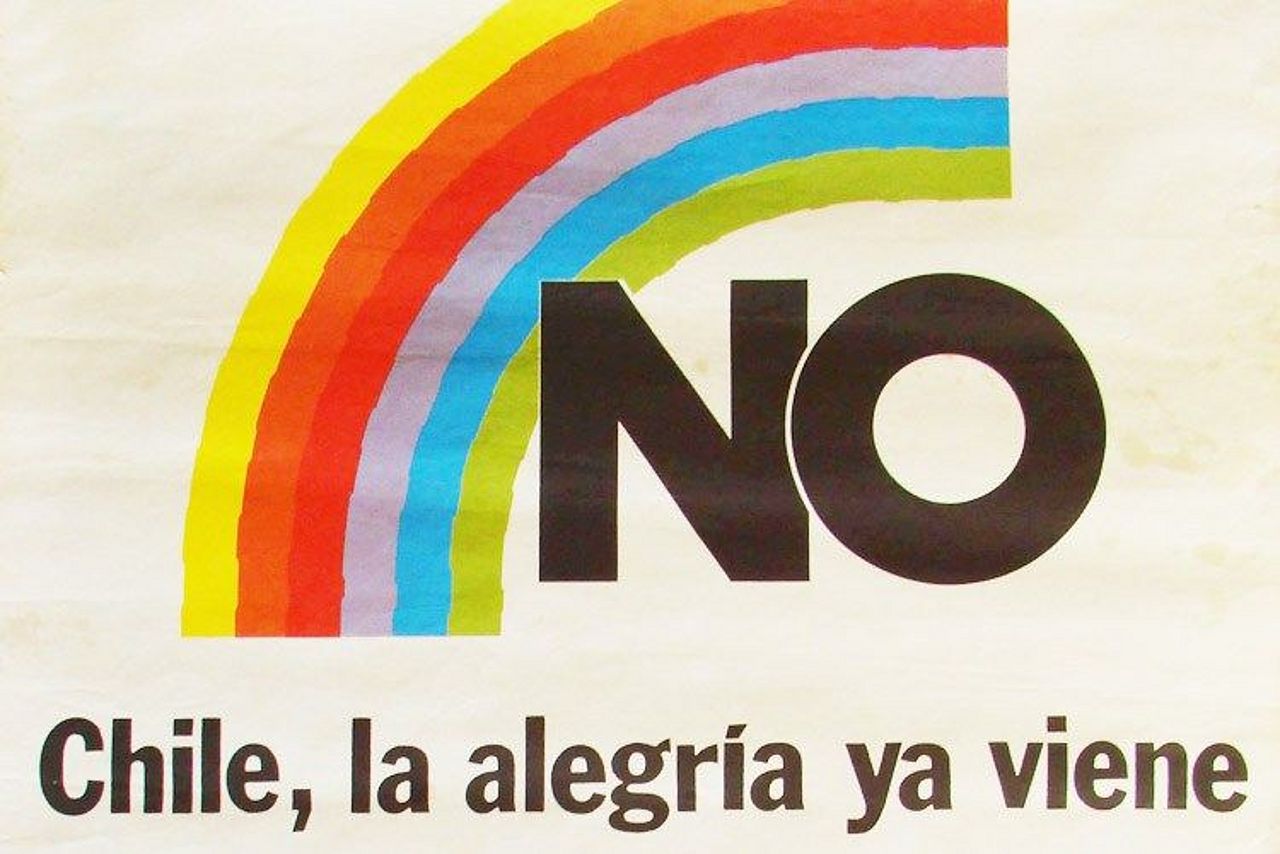
The poster says “Chile, la alegría ya viene” over a rainbow and a bold “NO.” It offers joy as a political promise, not just rejection. Original poster: Biblioteca Nacional Digital de Chile; accessible reproduction: Medical International.22
The jingle did not defeat Pinochet by itself. It helped make opposition feel safe, normal, collective, and desirable. It helped turn a political campaign into a community people wanted to belong to.
We need humor, friendship, belonging, generosity, and moments where the work itself feels like a glimpse of the world we are trying to build.
We cannot spend all our energy running away from what is broken. At some point, we need to start running toward something we love.
We need to make the preferred future more attractive than the status quo.
Doing the work at all turned out to be its own reward. Not because the problems are solved. Not because success is guaranteed. Because it has helped me feel more connected to the kind of person I wanted to become.
So if you think you’re protecting yourself by shielding yourself from action, I understand. That was me, too.
But maybe the question is not only: What do I oppose?
Maybe it is also: What do I want badly enough to build with other people?
That answer may be the beginning of our leverage.
And maybe it is also the beginning of coming alive.
Sending you my best,
Muxin
References
Footnotes
-
Martin Gilens and Benjamin I. Page, “Testing Theories of American Politics: Elites, Interest Groups, and Average Citizens,” Perspectives on Politics 12, no. 3 (2014): 564–581. PDF provided in the original notes. ↩ ↩2
-
For evidence on campaign spending and election outcomes, see Gary C. Jacobson, “The Effects of Campaign Spending in Congressional Elections,” American Political Science Review 72, no. 2 (1978): 469-491, citation record; Steven D. Levitt, “Using Repeat Challengers to Estimate the Effect of Campaign Spending on Election Outcomes in the U.S. House,” Journal of Political Economy 102, no. 4 (1994): 777-798, article; and Thanh Le, Ilke Onur, Rubayat Sarwar, and Erkan Yalcin, “Money in Politics: How Does It Affect Election Outcomes?” SAGE Open 14, no. 4 (2024), article. The research supports a strong relationship between spending and outcomes, especially for challengers, but it does not support treating fundraising as the only or universally strongest predictor of victory. ↩ ↩2
-
Scot Nakagawa, “A Lesson From My Grandparents: How Immigrant Workers Brought Down Jim Crow In Hawai’i,” The Anti-Authoritarian Playbook, source shared in the original notes. The account describes the Big Five plantation companies, the ethnic divisions that weakened earlier strikes, and the ILWU’s cross-ethnic organizing during the 1946 Hawai’i sugar strike. Supporting historical sources include the ILWU archive’s Frank Thompson oral history, the ILWU archive’s account of sugar and pineapple workers uniting against racism and poverty, and Hawai’i Public Radio’s history of the 1946 sugar strike. ↩ ↩2
-
“1946 Sugar Strike Picket, Hilo,” ILWU Archive. The image shows a community picket during the Hawai’i sugar strike and is reproduced from the archive’s public image file. ↩
-
Doctors Without Borders / Médecins Sans Frontières, “What We Do” and “Access to Medicine and Medical Care”. ↩
-
After-school care estimates vary significantly by location and type of care. One 2025 estimate puts program-based care at roughly $150 to $750 per month, or approximately $10,800 to $54,000 over six school years for one child. See Winnie, “How Much Does After-School Childcare Cost in 2025?”. “Hundreds of thousands” is probably too high for one child’s after-school care alone, but could become plausible across multiple children, many years, summer care, and other household support. ↩
-
“Garment Workers on Strike, New York City circa 1913,” Wikimedia Commons. The signs include “We demand 8 hours work day!” ↩
-
Vital Farms, “The Farm”. Image source for the pasture-raised hens. ↩
-
Heather Timmons, “It Ain’t the Same: Inside the Bitter Battle to Free Ben & Jerry’s”, The Guardian, July 31, 2026. ↩
-
The Grocer, “Ben & Jerry’s co-founder develops ice cream in support of Palestine”. The image is included as a private-note reference to the public protest described in the text. ↩
-
“Starbucks Workers United union protest Tallahassee,” Wikimedia Commons. The accompanying campaign reference is Starbucks Workers United, “Take Action”. ↩
-
Rachel Karten, @milkkarten, screenshot shared by the author. The screenshot reports 1.7 million views for a post about small businesses declaring that they do not use AI flyers or photos. Related reporting: Axios, “Utah small businesses are rejecting AI-generated flyers” and Eater, “Restaurants lean into handmade elements during AI flyer backlash”. ↩ ↩2
-
The deliberative-democracy claim should eventually have a dedicated source. The relevant body of research generally finds that structured deliberation can improve the quality, knowledge, and collective reasoning of public decisions. This sentence is currently framed as an idea to explore rather than as a settled factual claim. ↩
-
OECD, Innovative Citizen Participation and New Democratic Institutions: Catching the Deliberative Wave (Paris: OECD Publishing, 2020), Figure 2.2, p. 37, report. The image in the note is a crop of the report’s published figure. ↩
-
James Clear, Atomic Habits (Avery, 2018). ↩
-
Personal story visual generated for this draft with built-in image generation. It is an interpretive illustration, not a documentary image. ↩
-
Scot Nakagawa, “How a Jingle Defeated a Dictator”, The Anti-Authoritarian Playbook, August 10, 2026. The article discusses Chile’s 1988 “No” campaign and its use of music, humor, celebration, and a positive vision of the future as political strategy. ↩
-
“Chile, la alegría ya viene. Gana el NO,” Biblioteca Nacional Digital de Chile, and “Chile, la alegría ya viene,” medico international. The poster image is from the latter’s accessible reproduction of the archival material. ↩